


 Video Converter Ultimate
 Screen Recorder
 Video Repair
 Secure Download
Quick Guide to Easily Determine Your DVD Capacity [2024]
DVC capacity varies depending on their formats, design, and intended use. DVD formats like DVD-5, DVD-9, DVD-10, and DVD-18 each offer unique storage capabilities that can significantly impact how much data you can store. On the other hand, it can also cause confusion, especially with their capacity.
In this article, we are not going to leave you confused. Let’s learn and understand all these types of DVD formats and eventually determine what capacity they can hold. Moreover, we will clarify the difference between claimed and actual capacities on how various factors, such as the number of layers and the type of content stored, can affect the usable space on your discs. Let’s get started!

Part 1. DVD Formats
As introduced earlier, there are various types of video formats, and each is unique and different based on its DVD storage capacity, structure, and more.
• DVD-5 is a single-layer DVD that holds up to 4.7 GB of data, equivalent to approximately two hours of video, depending on compression. It is widely used for standard movies and data storage due to its compatibility with most DVD players.
• DVD-9 is a dual-layer, single-sided DVD, the DVD-9 can hold up to 8.5 GB of data, translating to around four hours of video. It features a solid and semi-transparent layer, allowing for higher-quality video storage.
• DVD-10 is a two-sided DVD that holds up to 9.4 GB of data, or about 4.5 hours of video. While it offers more capacity, it requires flipping the disc to access content on the other side, as there is no interactivity between sides. DVD-10s are often used to combine NTSC and PAL formats on a single disc.
• DVD-18 is the largest standard format among all DVD formats; this features two dual layers on each side, allowing for approximately 17 GB of data storage.
Part 2. DVD Capacity
Choosing the right DVD format can be tricky, especially if you’re unfamiliar with each type’s actual storage capacity. Many users mistakenly assume all DVDs hold the same amount of data, only to find their content doesn’t fit or the quality suffers. With this, in the table below, we simplified how you can compare each of the DVD formats, including their acclaimed capacity, actual capacity, layers, and length.
| DVD Format | Acclaimed Capacity (GB) | Actual Capacity (GB) | Layers | Length (Hours) |
| DVD-5 | 4.7 | 4.38 | 1 | 2 |
| DVD-9 | 8.5 | 7.95 | 2 | 4 |
| DVD-10 | 9.4 | 8.5 | 2 | 4.5 |
| DVD-18 | 17 | 15.9 | 4 | 8 |
We can conclude that each DVD format offers different DVD storage capacities, depending on the number of layers and sides they employ. While the claimed capacities provide a general guideline, the actual usable space is slightly lower due to formatting overhead. Single-layer DVDs, like the DVD-5, are suitable for shorter content with a capacity of approximately two hours. In contrast, dual-layer DVDs, such as DVD-9, DVD-10, and DVD-18, provide expanded storage options, accommodating longer video durations and higher-quality content.
Part 3. Bonus: Best Way to Save DVD Capacity
If you’re struggling with limited DVD storage space, the best way to preserve your movies is by ripping your DVD content into digital formats. This allows you to store your videos on your computer or external drive for easier access, sharing, and long-term backup—without risking damage to the original disc.
To solve this problem, you can use AnyMP4 DVD Ripper. This professional DVD ripping software can load DVDs directly from your DVD drive and convert them into widely used digital formats, including MP4, MOV, AVI, MKV, and more. With it, you can easily choose the format that best fits your needs and save your DVD content securely. In addition, it offers built-in editing tools that let you enhance your videos before ripping.
Main Features:
• Convert DVD to digital video for playback on PC and iOS/Android devices.
• Rip DVDs to popular formats like MP4, MKV, MOV, AVI, and many others.
• Advanced acceleration technology ensures fast ripping speed while maintaining high quality.
• Supports batch ripping to process multiple DVD titles at once.
• Built-in editing tools allow trimming, cropping, merging, adding watermarks, and adjusting effects.
• Customize output settings such as codec, resolution, bitrate, frame rate, and audio parameters.
• Simple and intuitive interface suitable for all users.
Free DownloadFor Windows 7 or laterSecure Download
Free DownloadFor MacOS 10.7 or laterSecure Download
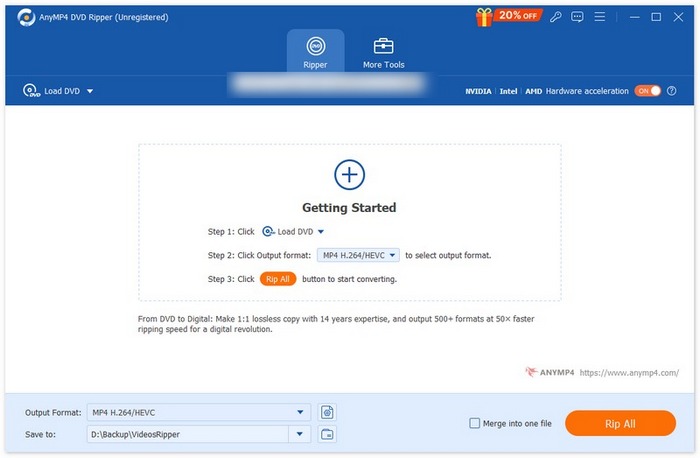
Here’s How to Use AnyMP4 DVD Ripper to Save DVD Content:
Step 1. Download and install AnyMP4 DVD Ripper on your Windows or Mac computer.
Free DownloadFor Windows 7 or laterSecure Download
Free DownloadFor MacOS 10.7 or laterSecure Download
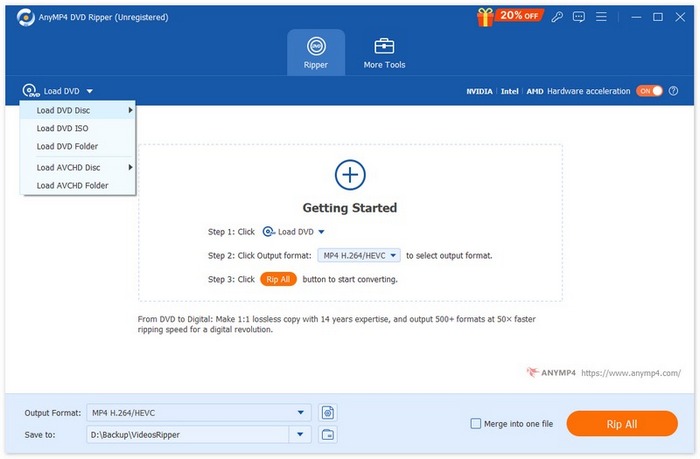
Step 2. Insert your DVD into the computer’s DVD drive and wait for it to be detected. Then launch the software and click “Load DVD” to import the disc.
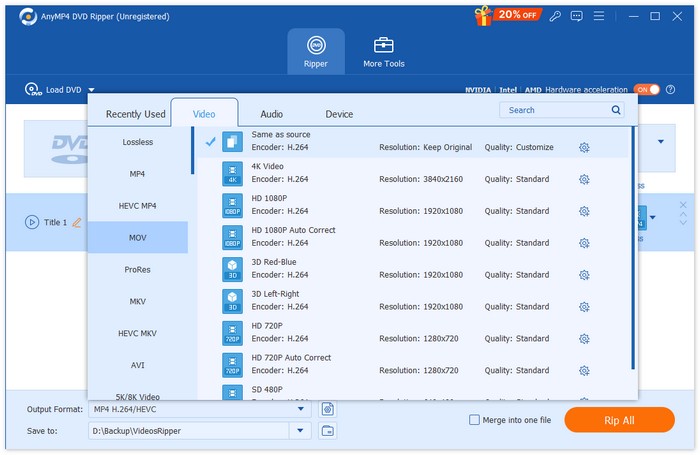
Step 3. Click the Output Format option and select your preferred digital format from the Video tab.
Step 4. Click “Rip All” to begin converting your DVD to a digital file.
With AnyMP4 DVD Ripper, saving your DVD content is simple and efficient. The intuitive interface makes the ripping process easy, and the wide range of supported formats ensures compatibility with virtually any device.
Part 4. FAQs about DVD Capacity
Can I use all types of DVDs in any DVD player?
Not all DVD formats are compatible with every DVD player that is available today. Most standard players can read DVD-5 and DVD-9, but other players may not support DVD-10 or DVD-18 formats. With this, you need to always check your player’s specifications for compatibility.
What should I do if my DVD is full but I need to store more content?
If your DVD is full, the best thing you can do is to rip it. You can use a DVD ripper tool to extract the media content from it and convert it to a digital file format. To do this, you can use the AnyMP4 DVD Ripper to easily rip your DVDs. This tool will allow you to store movies on your computer or external drives, saving more DVD capacity while making your content easier to access and share.
Are all DVDs the same size?
Yes. All standard DVDs are the same physical size. They measure 12 cm or 4.7 inches in diameter. However, they differ when it comes to their capacity and storage capabilities based on the format, such as DVD-5 and DVD-9, and the number of layers.
Conclusion
There you have it! You now have a clear picture of various DVD capacities based on their formats. But regardless of their sizes, what’s important is that you know how to save more DVD capacity by ripping your DVDs. So why wait? Start ripping your DVDs to maximize your DVD storage capacity today!
-
 Rip DVD to AVI: 3 Best DVD Ripper Softwares [Review]
 Want to rip your DVDs to AVI for easier playback and storage? Read our detailed review of the best DVD to AVI converters to find the perfect tool for you.
-
 3 Methods to Burn Video_TS to DVD on Windows and Mac
 Have the TS file on hand and want to save it on DVD, read this guide. We will teach you how to burn Video_TS to DVD on Windows or Mac computers in detail.
-
 How to Fix Windows Media Player Not Playing DVDs: 3 Methods
 Is the Windows Media Player not playing DVDs? It doesn't matter if your device is using Windows 7,8 or 10. You can find a solution. Here are the best players.
